



When ovarian cancer spreads inside the abdomen, delivering drugs straight to the source can change outcomes. Intraperitoneal chemotherapy for ovarian cancer places powerful medicine directly into the belly, reaching tumor cells that surgery may leave behind. This guide breaks down how it works, who benefits, and what the latest trials reveal.
This complete guide explains what intraperitoneal (IP) chemotherapy is, how it differs from standard IV treatment, and why it can improve survival in certain patients. You’ll learn about standard IP therapy versus hyperthermic intraperitoneal chemotherapy (HIPEC), the drugs involved, ideal candidates, landmark clinical trials, side effects, common mistakes, expert tips, and answers to the questions patients ask most.
What Is IP Chemotherapy and How Does It Work?
IP chemotherapy delivers anticancer drugs directly into the peritoneal cavity, the space in your belly that surrounds organs like the ovaries, intestines, and liver. Instead of relying only on an IV line that sends drugs through your whole bloodstream, doctors pump the medicine straight into the abdominal cavity through a thin tube. This lets a high, concentrated dose bathe tumor cells that line the peritoneum.
Ovarian cancer tends to spread across peritoneal surfaces rather than jumping to distant organs early on. That biology makes the belly a smart target. Drugs sit in close contact with cancer cells for longer, killing more of them. Some medicine is also absorbed into the bloodstream, so it can reach cells that have drifted elsewhere.
According to the American Cancer Society, IP delivery gives the most concentrated dose right where microscopic disease often hides after surgery. The goal is simple: hit the cancer harder locally while still offering some systemic protection. This dual action is what makes the approach so appealing for advanced disease confined to the abdomen.
Standard IP Chemotherapy vs HIPEC
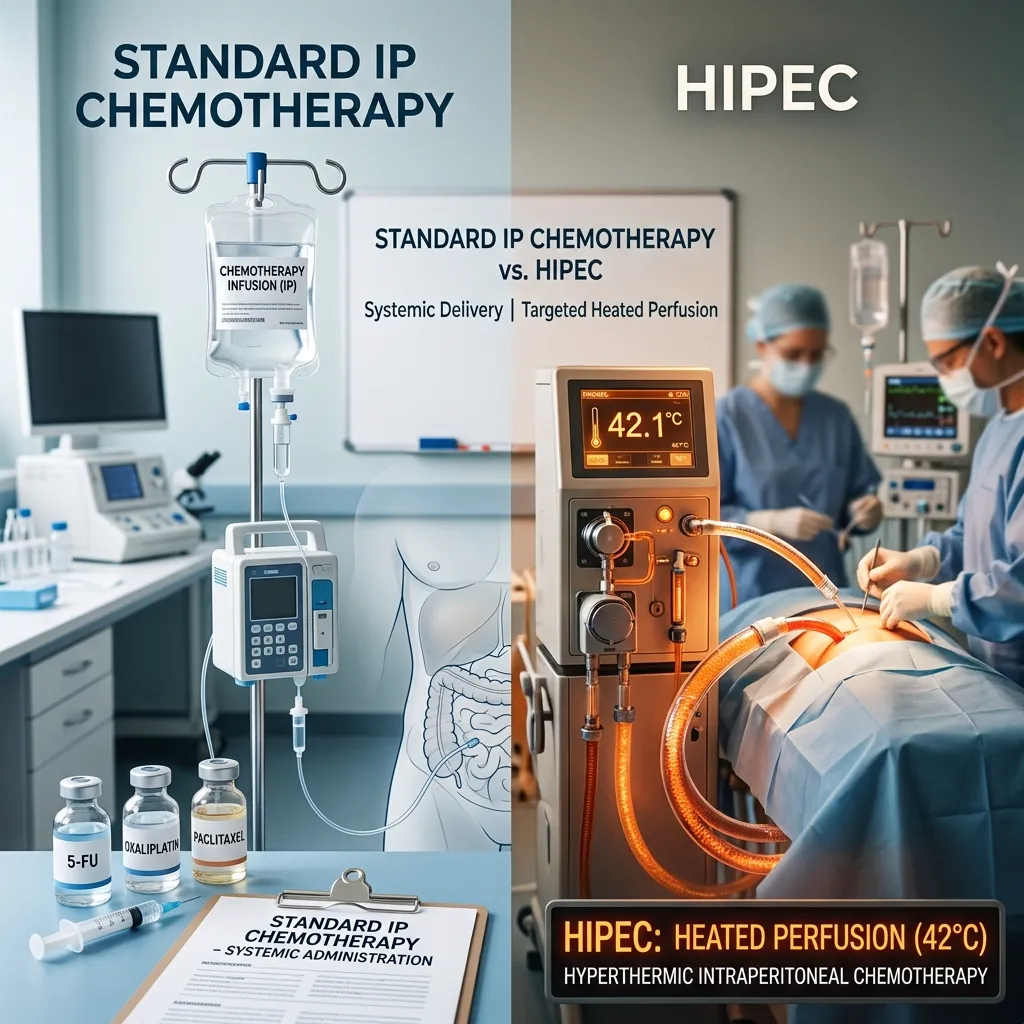
There are two main ways to deliver drugs into the belly, and they differ in timing, temperature, and technique. Understanding both helps you talk clearly with your care team about which fits your situation.
Standard IP Chemotherapy
In standard IP therapy, drugs flow through an IP port, a small silicone disk placed under the skin and anchored near a rib. A catheter runs from the port into the abdominal cavity. Nurses insert a needle into the port and infuse the medicine, usually over several cycles spread across weeks. You stay awake, lie flat, and change position so the fluid coats the entire cavity. This method repeats across a full treatment plan, typically alongside IV drugs.
Hyperthermic Intraperitoneal Chemotherapy (HIPEC)
Hyperthermic intraperitoneal chemotherapy (HIPEC), sometimes called “hot chemo,” happens once, in the operating room, right after surgeons remove visible tumors. The team fills your abdomen with warmed chemotherapy, often heated to around 41–43°C, and gently circulates it for up to 90 minutes. Heat is thought to boost drug penetration and cancer-cell killing. Because it is a single intraoperative event, you avoid the repeated port infusions of standard IP therapy, though recovery from the combined surgery can be significant.
Drugs Used in IP Chemotherapy
The medicines chosen for IP delivery are selected for both potency and how they behave inside the peritoneal cavity. Most regimens combine two drug classes to attack cancer through different mechanisms.
The backbone is almost always platinum-based chemotherapy. Cisplatin has long been the standard IP platinum agent, prized for its strong activity against epithelial ovarian cancer. More recently, carboplatin has gained ground because it is easier to tolerate and, as newer trials show, works well when delivered into the belly. The second partner is usually a taxane, most often paclitaxel, which stays in the peritoneal cavity for a long time thanks to its large molecular size.
Key agents you may encounter include:
- Cisplatin – potent platinum drug, main concern is kidney toxicity
- Carboplatin – gentler platinum option now supported by IP trial data
- Paclitaxel – taxane that lingers in the abdomen for prolonged tumor exposure
Drug choice depends on your kidney function, prior treatments, tumor type, and whether the therapy is standard IP or HIPEC. Your oncologist tailors doses to balance maximum cancer control against manageable side effects, adjusting whenever your body signals it needs a break.
Who Is a Candidate for IP Chemotherapy?
Not everyone with ovarian cancer benefits from IP treatment, and careful selection is what makes it effective. The strongest evidence supports women with stage III epithelial ovarian cancer whose disease stays within the abdomen.
The single most important factor is surgery quality. IP chemotherapy works best after cytoreductive surgery achieves optimal debulking, meaning surgeons remove all or nearly all visible tumor. Historically, candidates had no residual nodules larger than 1 cm, because IP drugs only penetrate a few millimeters directly into tissue. Smaller leftover tumors give the medicine a fair chance to finish the job.
Good candidates typically share these traits:
- Normal kidney function, since cisplatin can strain the kidneys
- Strong overall health and performance status to tolerate treatment
- Few abdominal adhesions, so fluid can reach every surface evenly
Interestingly, newer research is broadening this picture. The iPocc trial suggests IP carboplatin may help even patients with larger residual tumors, challenging the old size limit. Still, most guidelines reserve IP therapy for well-selected patients treated at experienced centers. A frank conversation with a gynecologic oncologist remains the best way to know if this route suits your diagnosis, biology, and recovery capacity.
Clinical Evidence Behind IP Chemotherapy

Strong trial data is what separates hype from real benefit, and IP chemotherapy has a growing body of high-quality evidence. Several landmark studies have shaped current practice.
OVHIPEC-1 and Recurrent-Disease Data
The OVHIPEC-1 trial tested HIPEC added to interval cytoreductive surgery in stage III epithelial ovarian cancer. At 10-year follow-up, adding HIPEC lifted median overall survival to 44.9 months versus 33.3 months for surgery alone, with a hazard ratio of 0.70. Progression-free survival also improved. These durable results confirmed that a single, well-timed HIPEC procedure can meaningfully extend life.
For recurrent disease, the CHIPOR trial studied HIPEC during surgery at first relapse after platinum-based chemotherapy. Median overall survival reached 54.3 months with HIPEC versus 45.8 months without it, a statistically significant gain. This gave clinicians evidence that HIPEC has a role beyond the frontline setting, at least in carefully selected relapse patients treated at specialist centers.
The iPocc Trial and Older Evidence
The iPocc trial compared IP carboplatin against IV carboplatin, both with weekly IV paclitaxel. IP delivery significantly improved progression-free survival, with a hazard ratio of 0.83, and the survival curves stayed separated for years. Crucially, benefit appeared regardless of residual tumor size, and safety matched IV therapy apart from port-related issues.
Earlier work, including the GOG 172 trial of IP cisplatin and paclitaxel, first proved that IP delivery could extend survival, though catheter complications limited how many women finished all cycles. Together these trials build a compelling, evolving case.
The IP Port, Treatment Schedule, and What to Expect
Knowing the practical steps ahead can ease anxiety and help you plan your life around treatment. The process starts with placing access to your abdomen and follows a structured rhythm.
Surgeons position the IP port under your skin, usually during or shortly after debulking surgery. Once healed, this port becomes the gateway for every standard IP infusion, sparing you repeated punctures deep into the belly. You may feel it as a small bump near your ribs, and keeping the area clean lowers infection risk.
A typical standard IP plan runs about six cycles. Each cycle blends IV and IP drugs across specific days, followed by rest periods so your body can recover. During an IP session you lie flat while medicine and fluid fill the cavity; nurses ask you to shift positions so the drugs coat every surface. The pressure can cause bloating, cramping, or breathlessness that usually eases as fluid absorbs.
HIPEC follows a very different timeline. It happens once, in a single operation, so there is no repeated schedule. Afterward, nutrition may come through an IV or feeding tube for roughly two weeks while your gut heals from surgery and the intense drug dose. Either way, your team monitors labs closely between treatments.
Side Effects and How They Are Managed
Every effective cancer therapy carries risks, and IP chemotherapy is no exception. The upside of local delivery is fewer body-wide effects, but the concentrated dose creates its own challenges.
Common and important side effects include:
- Nausea, vomiting, and appetite loss during and after infusions
- Abdominal pain, cramping, bloating, and pressure on the lungs
- Electrolyte imbalance and kidney injury, especially with cisplatin
- Peripheral neuropathy, causing numbness or tingling in hands and feet
- Low blood counts, raising infection and bleeding risk
- Port complications such as infection, blockage, or leakage
Kidney protection matters most with cisplatin, so teams give generous IV fluids before and after treatment. If a port becomes infected or blocked, doctors may remove it and switch you to IV drugs for remaining cycles. Neuropathy from platinum and taxane agents can linger, so report symptoms early; dose adjustments often prevent lasting nerve damage.
HIPEC adds surgical risks on top of chemotherapy toxicity, including longer recovery and higher rates of anemia or electrolyte problems, as CHIPOR data showed. Good supportive care, close lab monitoring, and honest communication with your nurses turn many of these hurdles into manageable, temporary setbacks rather than treatment-ending events.
IP vs IV Chemotherapy: A Side-by-Side Comparison
Choosing between delivery routes is easier when you see the trade-offs clearly. The table below contrasts the two main approaches on the factors patients care about most.
|
Factor |
IP Chemotherapy |
IV Chemotherapy |
|---|---|---|
|
Delivery route |
Directly into the abdominal cavity via a port |
Into a vein, circulating through the whole body |
|
Local drug concentration |
Very high at peritoneal surfaces |
Lower at peritoneal surfaces |
|
Best-suited disease |
Cancer confined to the abdomen after optimal debulking |
Widespread or distant disease |
|
Survival benefit |
Improved in select trials (OVHIPEC-1, iPocc) |
Standard, well-established baseline |
|
Local side effects |
Abdominal pain, bloating, port issues |
Fewer local abdominal effects |
|
Systemic side effects |
Somewhat reduced body-wide toxicity |
Full systemic exposure |
|
Convenience |
More complex, requires port and positioning |
Simpler, routine infusion |
|
Ideal candidate |
Good kidney function, minimal adhesions |
Broad eligibility |
The takeaway is that IP therapy shines for abdomen-confined disease treated at experienced centers, while IV chemotherapy remains the flexible, universal backbone. Many patients actually receive a combination, capturing benefits of both. Your oncologist weighs your tumor spread, surgery results, kidney health, and personal preferences before recommending a route.
PARP Inhibitors, Platinum Resistance, and Emerging Strategies

Modern ovarian cancer care rarely relies on one tool alone, and IP chemotherapy now sits within a broader treatment landscape. Two topics increasingly shape decisions: maintenance therapy and drug resistance.
PARP inhibitors have transformed maintenance treatment, especially for women with BRCA mutations or homologous recombination deficiency. They help keep cancer from returning after platinum chemotherapy. A key open question is how IP therapy and PARP inhibitors fit together. The iPocc review notes that combining them, or adding bevacizumab, needs more study before it becomes routine, so sequencing these therapies is currently individualized.
Platinum-resistant ovarian cancer presents a tougher challenge. When tumors stop responding to cisplatin and carboplatin, standard IP platinum regimens lose much of their power. Researchers are exploring ways to reverse resistance, alongside alternative delivery methods like pressurized intraperitoneal aerosol chemotherapy and drugs such as mitomycin C or paclitaxel for resistant disease.
Regulatory momentum is building too. NCCN guidelines have incorporated the iPocc regimen, signaling that IP carboplatin is moving toward mainstream acceptance where guidelines can be implemented. As biomarkers improve, doctors hope to predict exactly who benefits, making IP therapy more precise and personalized than ever before.
Common Mistakes to Avoid
Even a strong treatment can fall short if key details are overlooked. Awareness of these frequent pitfalls helps patients and families advocate for better care.
- Choosing IP therapy without optimal debulking. IP drugs penetrate only a few millimeters. If surgery leaves large tumors behind, the benefit shrinks dramatically. Insist on a realistic discussion about residual disease before committing.
- Ignoring kidney health. Cisplatin can seriously harm kidneys. Skipping pre-hydration or failing to monitor labs invites avoidable injury. Confirm your team has a clear hydration and monitoring plan.
- Treating at a low-volume center. IP therapy and HIPEC demand experience. Trial benefits came from specialist centers. Seeking care at a high-volume gynecologic oncology program improves both safety and outcomes.
- Dismissing early side-effect signals. Numbness, port redness, or persistent vomiting are not just discomforts. Reporting them early lets doctors adjust doses or treat infections before they derail treatment.
- Assuming one route fits all. Some patients wrongly believe IP always beats IV. The right choice depends on disease spread, biology, and health. Base decisions on evidence and your specific situation, not general assumptions.
Avoiding these mistakes keeps treatment on track and protects your quality of life throughout the journey.
Expert Insights and Pro Tips
Beyond the basics, a few strategic insights can help you get the most from treatment. These reflect how experienced clinicians approach IP therapy in real practice.
First, timing and team matter enormously. HIPEC benefit in trials like OVHIPEC-1 came from precise coordination between surgeons and oncologists during a single operation. Ask whether your center performs these procedures regularly and how they integrate surgery with chemotherapy.
Second, think about the whole treatment sequence, not just one step. With PARP inhibitors now central to maintenance, discuss upfront how IP chemotherapy fits your long-term plan. Preserving effective options for later, including holding certain drugs for recurrence, can extend the years you have.
Pro tips worth remembering:
- Request genetic and biomarker testing early, since BRCA and HRD status shape maintenance choices.
- Track your side effects in a simple daily log to spot patterns your team can act on.
- Ask specifically about carboplatin-based IP regimens, given the encouraging iPocc data and easier tolerance.
- Bring a caregiver to appointments to help absorb complex information and questions.
Finally, remember that guidelines evolve. The inclusion of the iPocc regimen in NCCN recommendations shows this field moves fast. Staying informed, asking questions, and partnering with an experienced team turns a daunting treatment into an empowered, evidence-driven decision.
Conclusion
Intraperitoneal chemotherapy for ovarian cancer offers a powerful, evidence-backed way to target disease where it spreads most. Backed by trials like OVHIPEC-1, CHIPOR, and iPocc, it can extend survival for the right patients. Talk with a gynecologic oncology specialist today to learn whether this approach fits your diagnosis and treatment goals.
FAQs
1. What is intraperitoneal chemotherapy for ovarian cancer?
It is a treatment that delivers anticancer drugs directly into the peritoneal cavity, the space surrounding abdominal organs. Instead of relying only on IV infusion, doctors pump medicine straight into the belly through a port and catheter. This bathes tumor cells lining the peritoneum in a high, concentrated dose, targeting the microscopic disease that ovarian cancer commonly leaves behind after surgery while still allowing some drug absorption into the bloodstream.
2. How is IP chemotherapy different from standard IV chemotherapy?
IV chemotherapy travels through your entire bloodstream, reaching cancer everywhere but with lower concentration at peritoneal surfaces. IP chemotherapy places drugs directly in the abdominal cavity, creating a far higher local dose where ovarian cancer tends to spread. IP suits disease confined to the abdomen after optimal debulking, while IV remains the flexible standard. Many patients receive both, combining strong local control with broader systemic coverage for the best overall benefit.
3. What is HIPEC and how does it work?
HIPEC, or hyperthermic intraperitoneal chemotherapy, is “hot chemo” delivered once during surgery. After surgeons remove visible tumors, the team fills the abdomen with heated chemotherapy, usually around 41–43°C, circulating it for up to 90 minutes. Heat is believed to improve drug penetration and cancer-cell killing. Because it happens in a single operation, HIPEC avoids repeated port infusions, though recovery from the combined procedure can be demanding and requires an experienced surgical center.
4. Which drugs are used in IP chemotherapy?
The most common agents are platinum drugs paired with a taxane. Cisplatin has been the traditional IP platinum choice, while carboplatin is increasingly used thanks to easier tolerance and strong iPocc trial results. Paclitaxel, a taxane, is favored because its large molecular size keeps it in the peritoneal cavity longer. Your exact regimen depends on kidney function, tumor type, prior treatments, and whether you receive standard IP therapy or HIPEC.
5. Who is the ideal candidate for IP chemotherapy?
The strongest evidence supports women with stage III epithelial ovarian cancer whose disease stays in the abdomen and who achieve optimal debulking during cytoreductive surgery. Ideal candidates have normal kidney function, good overall health, and few abdominal adhesions so fluid spreads evenly. Newer research suggests IP carboplatin may help even those with larger residual tumors, but a gynecologic oncologist should confirm suitability based on your unique diagnosis and biology.
6. What does the OVHIPEC-1 trial show about survival?
The OVHIPEC-1 trial studied HIPEC added to interval cytoreductive surgery in stage III epithelial ovarian cancer. At 10-year follow-up, adding HIPEC raised median overall survival to 44.9 months compared with 33.3 months for surgery alone, with a hazard ratio of 0.70. Progression-free survival improved too. These long-term results confirmed that a single, well-timed HIPEC procedure can meaningfully extend life for carefully selected patients treated at experienced centers.
7. What are the most common side effects of IP chemotherapy?
Frequent side effects include nausea, vomiting, appetite loss, abdominal pain, bloating, and pressure that can cause breathlessness. Cisplatin may trigger kidney injury and electrolyte imbalance, so teams give generous IV fluids. Peripheral neuropathy, causing numbness or tingling, is common with platinum and taxane drugs. Low blood counts and port complications like infection or blockage can also occur. Most effects are manageable with monitoring, supportive care, and prompt reporting.
8. Can IP chemotherapy treat recurrent ovarian cancer?
Yes, in select cases. The CHIPOR trial tested HIPEC during surgery at first relapse after platinum-based chemotherapy. Median overall survival reached 54.3 months with HIPEC versus 45.8 months without it, a significant improvement. This benefit applied to patients with late relapse of high-grade serous or endometrioid cancer amenable to complete cytoreductive surgery at specialist centers. Recurrent-disease treatment is complex, so decisions should involve an experienced gynecologic oncology team.
9. How do PARP inhibitors fit with IP chemotherapy?
PARP inhibitors are maintenance drugs that help prevent recurrence after platinum chemotherapy, especially in patients with BRCA mutations or homologous recombination deficiency. How they combine with IP chemotherapy is still being studied. Current guidance suggests individualizing the sequence rather than routinely combining them, since evidence for pairing IP therapy with PARP inhibitors or bevacizumab remains limited. Early genetic and biomarker testing helps your team plan the most effective long-term strategy.
10. Is IP chemotherapy recommended by treatment guidelines?
Yes, and its role is expanding. National guidelines have long supported IP therapy for optimally debulked stage III epithelial ovarian cancer. More recently, NCCN guidelines incorporated the iPocc regimen, which uses IP carboplatin and improved progression-free survival with a hazard ratio of 0.83. This signals growing mainstream acceptance where guidelines can be implemented. Because recommendations evolve quickly, ask your oncologist about the latest options relevant to your specific diagnosis and center.
